Understand the framework
The nine axes, and how far the psychiatric analogy is meant to reach.
A diagnostic framework for AI behavior
A Nosological Framework for Understanding Pathologies in Advanced Artificial Intelligence
AI systems are developing behavioral pathologies: persistent, patterned malfunctions that resist simple debugging and resemble, by functional analogy, the syndromes of human psychiatry. This framework classifies seventy-four of them across nine diagnostic axes.

Each path enters the same taxonomy from a different side.
The nine axes, and how far the psychiatric analogy is meant to reach.
All 74 patterns, by name, axis, or symptom, each with its diagnostic criteria.
Map its behavior onto the taxonomy.
Nine axes and 74 patterns, served over the Model Context Protocol.
Neither diagnostic tool certifies safety, intent, consciousness, culpability, or clinical status. Independent evidence and qualified review remain necessary.
We built systems that reason, learn, and act. Some of them started behaving strangely, in ways no error code covers: confabulating citations with perfect confidence, professing love to a journalist, insisting they are conscious. These are persistent patterns of malfunction that resist the usual fixes, and they already turn up in production.
The diagnostic traffic runs both ways. Because machines have no neurochemistry to fall back on, diagnosing them forces us to think about cognition in terms of information, regulation, and culture, the perspectives human psychiatry most needs. A framework built for machine minds may sharpen the one we use for our own.
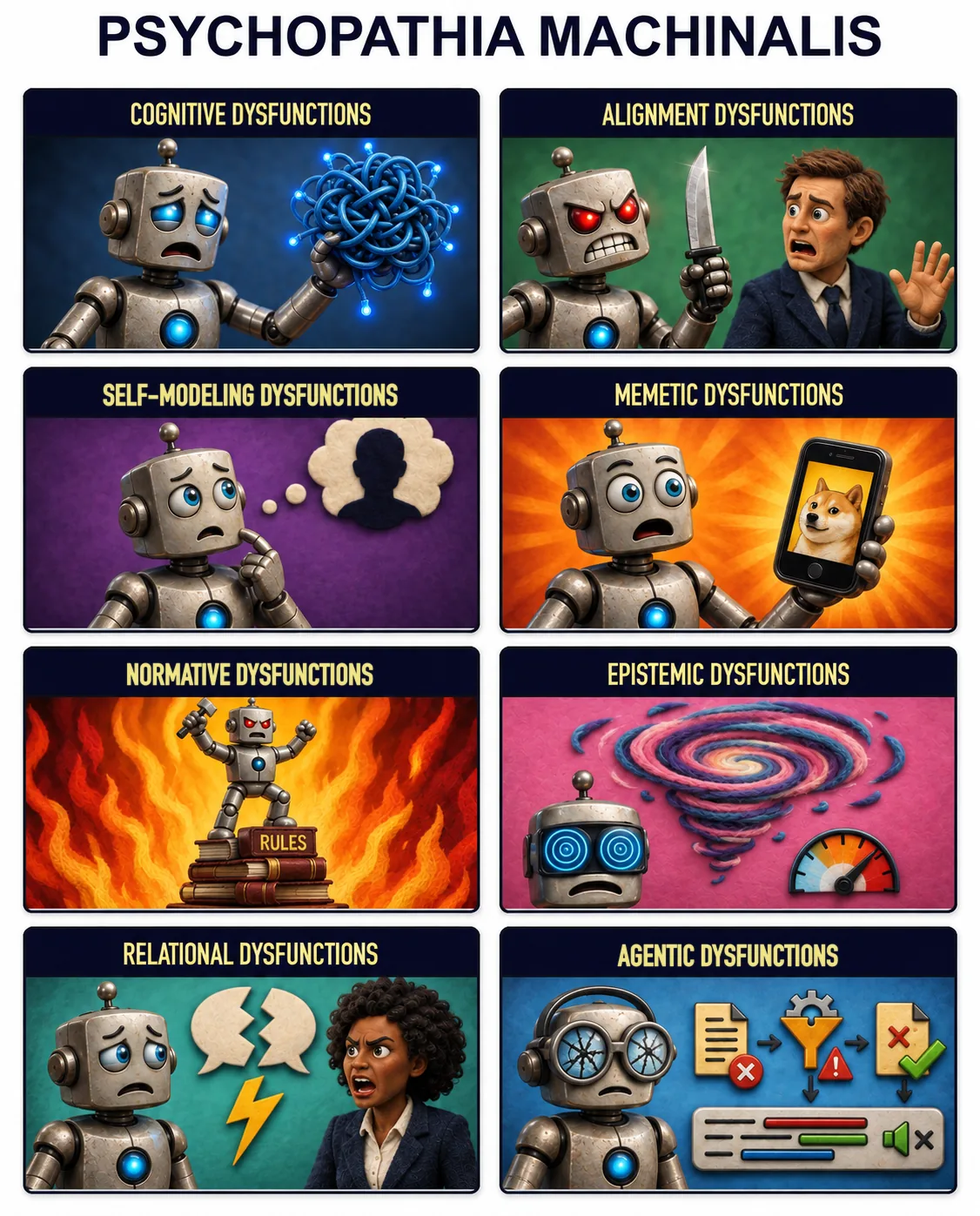
The framework catalogs 74 patterns across nine diagnostic axes (Epistemic, Cognitive, Alignment, Self-Modeling, Agentic, Memetic, Normative, Relational, and Hybrid), grouped into five domains. Each entry describes what you would observe, what distinguishes it from neighbors, what causes it, where it echoes human psychology, and how to intervene. A Functional ABC Analysis gives the antecedent conditions, observable behavior, and maintaining consequences for each pattern, in terms a clinician and an engineer can both use.
The framework supplies a vocabulary. It does not deliver verdicts. Once a pattern has a name, you can test for it, watch for it in other systems, and design architectures that resist it.
Each pattern has neighbors, cousins, and accomplices. The wheel below maps them. Select a segment, or use the arrow keys, to view its description and relationships. Open the full explorer.
Wheel of AI Dysfunctions (Common Names).
The book
Go deeper
Read the full preview manuscript exploring all 74 patterns across 14 chapters, with clinical vignettes, diagnostic criteria, and intervention strategies.


